
Weatherby Crossing
Click here for Inquiry notice received December 2021
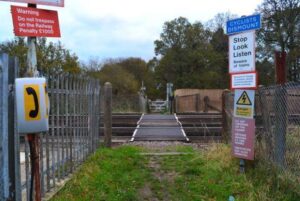
Recognition of public rights of way over the Weatherby level crossing in Newmarket
Following a 9-day inquiry that took place, partly in the Town Hall and partly on-line (as a blended event) during October and November 2020, an Inspector has published an interim decision. This decision proposes confirmation of the Suffolk County Council (Parish of Newmarket) Modification Order 2018, subject to proposed modifications.
The Order recognises the existence of a public right of way over the Weatherby level crossing which lies in the heart of Newmarket and serves as a key access point for members of the local community.
Network Rail had previously sought to close the crossing through the Network Rail (Suffolk Level Crossing Reduction) Order (“TWA Order”). Following the TWA Inquiry (in spring 2018) the Secretary of State removed the crossing from the Order. The TWA Inspector concluded both that the alternative route suggested was not a convenient and suitable replacement for existing users, and that there was no compelling case in the public interest to justify the closure of the crossing. (see here [to add hyperlink to website item on Suffolk level crossing reduction order]).
During the TWA Inquiry, the question as to the status of rights at the crossing arose as there was no record of the public right of way for the crossing. It was agreed that the correct procedure for determining this issue was the statutory procedure set out in the Wildlife and Countryside Act 1981 for definitive map modification order (“DMMO”) applications. A DMMO application was then duly made by an interested member of the public, which ultimately led to the more recent 9-day inquiry.
Whilst Suffolk County Council considered there to be sufficient evidence to make the Order, it took a neutral stance as to whether it should be confirmed. This resulted in Newmarket Town Council taking over responsibility for presenting the case in support of confirmation. Network Rail was the only objector to the Order.
The Inspector concluded among on things that on balance, the evidence as a whole, was supportive of the claimed route having been dedicated as a highway prior to the construction of the railway. In particular, he placed significant weight on a number of railway documents, contemporaneous with the construction of the railway, which referred to the route as a public road. Further documents that had passed through the Parliamentary process were supportive of this position. Contrary documents relied on by the objector were not of sufficient evidential weight to outweigh the railway documents. The Inspector also placed significant reliance on witness evidence that provided personal evidence of use dating back to the 1930s, which (along with further documentary evidence, including a number of old newspaper reports) was consistent with an earlier dedication of the route as a highway.
Overall, in light of the evidence before him, the Inspector concluded that the route had the status of a restricted byway (i.e. use includes that of cyclists as well as pedestrians etc.) and so has proposed modifications to the order to reflect that status.