Grenadier Guards
King Charles II, The First Guards and Newmarket
by Major Paul Cordle formerly Grenadier Guards.
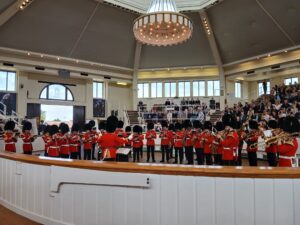
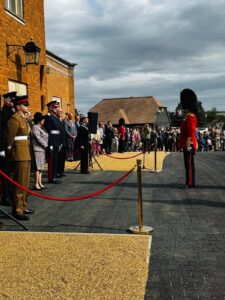
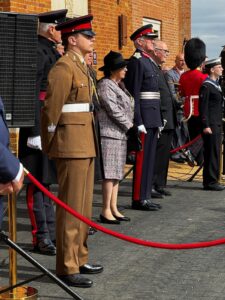
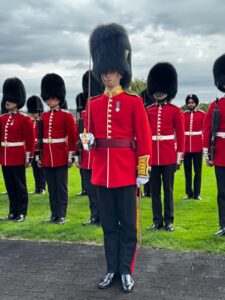
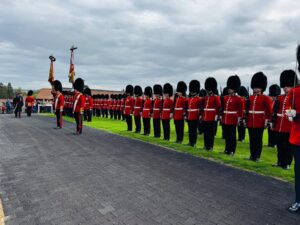
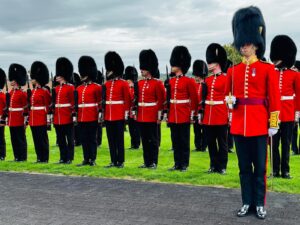
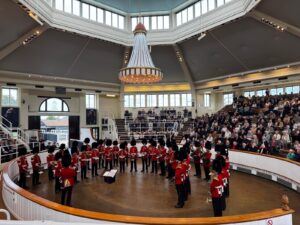
The Streets of Newmarket were abuzz with excitement in the morning of Saturday 12th September as large crowds of spectators waited for Nijmegen Company and the Band of the Grenadier Guards. They were about to exercise the Regiment’s newly bestowed Freedom of Newmarket by marching through the town with ‘drums beating, colours flying and bayonets fixed’. It was a proud moment for the Regiment and indeed Newmarket which joins an elite group of cities who have similarly honoured the regiment (1)
In the past, to grant the Freedom of a town or city, in essence the handing over of its keys or ‘the right of entry’, was the ultimate sign of trust in a person or an armed body of men; it goes back to ancient times and, to this day, is highly valued by recipients.
Although never walled and gated , Newmarket takes pride in its rich heritage. In medieval times it held one of the earliest market charters in England, granted by King Henry III in 1220, hence its name New Market.
The town’s fame grew as the market grew and, spectacularly so, in the 1600s when James I, his son Charles I and grandson Charles II made it fashionable to race there. It became home to the Jockey Club in 1752 and, in 1965, to Tattersalls which had been established in London two centuries earlier in 1766. Recognised as the centre of racing in Britain, the late Queen opened the National Horse Racing Museum in Palace House in Newmarket in 1983.
The real key to the Newmarket story lies with Charles II. A passionate man, who made no bones about indulging himself to the full, would have been fun to be with especially at his happiest , as he would say, when ‘a racing at Newmarket’. He had grown to enjoy the sport when accompanying his father Charles I. By the age of ten he was an accomplished horseman; much later, after the Restoration, the Duke of Newcastle wrote of him “No man makes a horse go better than I have seen some go under His Majesty for the first time ever he came upon their backs which is the quintessence of the art”. He often rode in races and won several.
Charles II returned to Newmarket as King for the first time in 1666, five years after his Restoration, and would go there for prolonged visits two or three times a year. He would leave London with his Court before light, as early as 3.00 am, to reach Newmarket in time for racing and not always without mishap. Samuel Pepys
recorded the occasion when the King’s coach overturned at King’s Gate in Holborn “The King all dirty but no hurt”.
In the early days the King stayed at Audley End, eventually buying it from the Earl of Suffolk in 1669 for £50,000. In due course he was to build a palace in Newmarket. Although modest by London standards, it stood out from surrounding buildings being sufficiently large to accommodate his immediate household and some of the court; other took lodgings in the town or camped on the Heath, together with their servants, baggage, and all the hangers-on that such a gathering attracted.
Once the King had established a palace and was making regular visits to Newmarket, his courtiers built or acquired houses around the town and stables were added. As the popularity of racing grew so studs were set up to breed finer horses and the foundations of modern Newmarket and the racing industry were laid down.